An Introduction to Atmospheric Physics 2nd Edition – PDF/EPUB Version Downloadable
Author(s): David G. Andrews
Publisher: Cambridge University Press
ISBN: 9780521693189
Edition: 2nd Edition
$49,99
Delivery: This can be downloaded Immediately after purchasing.
Version: Only PDF Version.
Compatible Devices: Can be read on any device (Kindle, NOOK, Android/IOS devices, Windows, MAC)
Quality: High Quality. No missing contents. Printable
Recommended Software: Check here

Important: No Access Code
Description
A quantitative introduction to the Earth’s atmosphere for intermediate-advanced undergraduate and graduate students, with an emphasis on underlying physical principles. This edition has been brought completely up-to-date, and now includes a new chapter on the physics of climate change which builds upon material introduced in earlier chapters, giving the student a broad understanding of some of the physical concepts underlying this most important and topical subject. In contrast to many other books on atmospheric science, the emphasis is on the underlying physics. Atmospheric applications are developed mainly in the problems given at the end of each chapter. The book is an essential resource for all students of atmospheric physics as part of an atmospheric science, meteorology, physics, Earth science, planetary science, or applied mathematics course.
Related products
An Introduction to Atmospheric Physics 2nd Edition – PDF/EPUB Version Downloadable
Author(s): David G. Andrews
Publisher: Cambridge University Press
ISBN: 9780521693189
Edition: 2nd Edition
$49,99
Delivery: This can be downloaded Immediately after purchasing.
Version: Only PDF Version.
Compatible Devices: Can be read on any device (Kindle, NOOK, Android/IOS devices, Windows, MAC)
Quality: High Quality. No missing contents. Printable
Recommended Software: Check here
Important: No Access Code
Description
A quantitative introduction to the Earth’s atmosphere for intermediate-advanced undergraduate and graduate students, with an emphasis on underlying physical principles. This edition has been brought completely up-to-date, and now includes a new chapter on the physics of climate change which builds upon material introduced in earlier chapters, giving the student a broad understanding of some of the physical concepts underlying this most important and topical subject. In contrast to many other books on atmospheric science, the emphasis is on the underlying physics. Atmospheric applications are developed mainly in the problems given at the end of each chapter. The book is an essential resource for all students of atmospheric physics as part of an atmospheric science, meteorology, physics, Earth science, planetary science, or applied mathematics course.
Related products
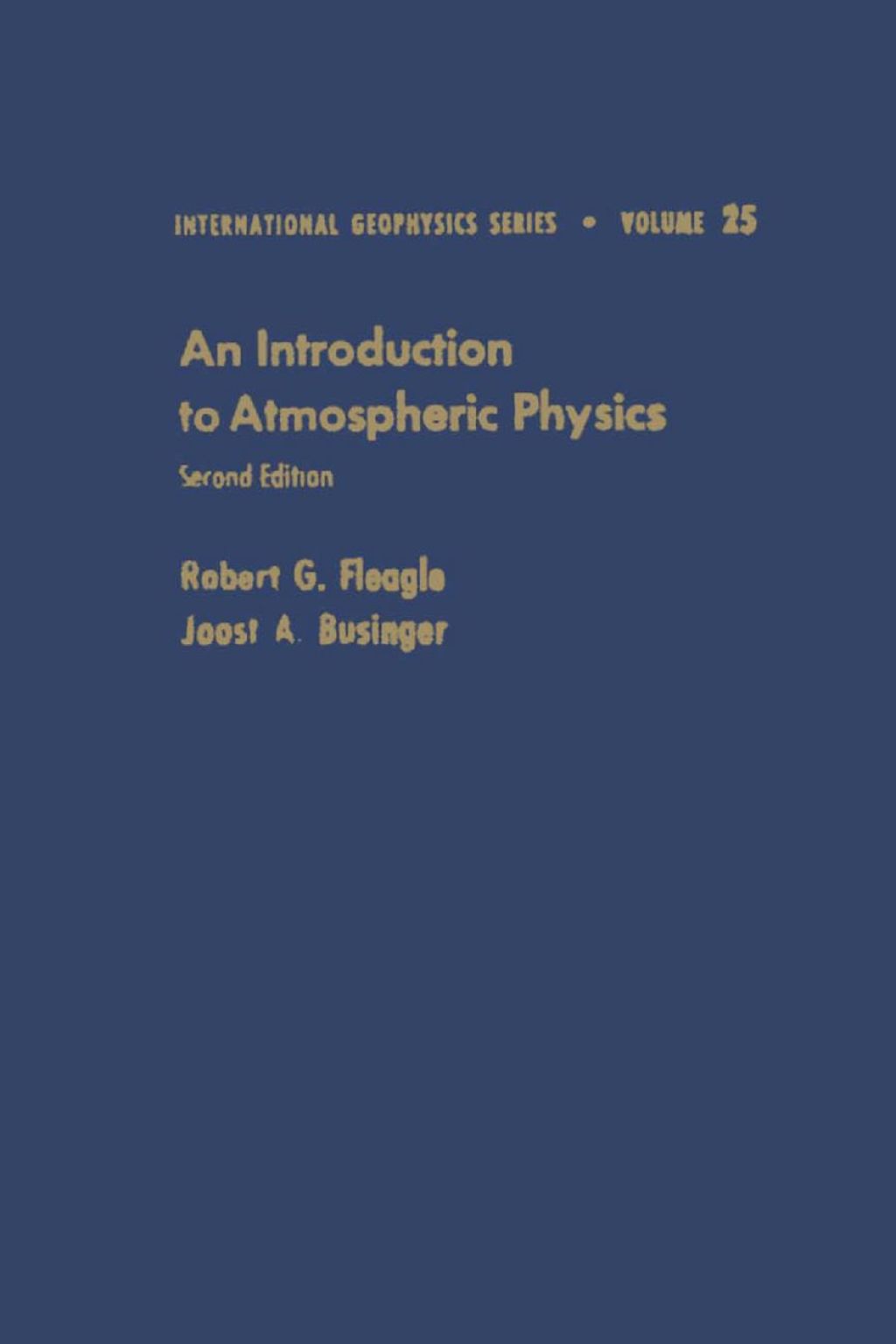
An Introduction to Atmospheric Physics 2nd Edition – PDF/EPUB Version Downloadable
Author(s): Fleagle, Robert G.; Businger, Joost A.
Publisher: Academic Press
ISBN: 9780122603556
Edition: 2nd Edition
$49,99
Delivery: This can be downloaded Immediately after purchasing.
Version: Only PDF Version.
Compatible Devices: Can be read on any device (Kindle, NOOK, Android/IOS devices, Windows, MAC)
Quality: High Quality. No missing contents. Printable
Recommended Software: Check here

Important: No Access Code
Description
This book is addressed to those who wish to understand the relationship between atmospheric phenomena and the nature of matter as expressed in the principles of physics. The interesting atmospheric phenomena are more than applications of gravitation, of thermodynamics, of hydrodynamics, or of electrodynamics; and mastery of the results of controlled experiment and of the related theory alone does not imply an understanding of atmospheric phenomena. This distinction arises because the extent and the complexity of the atmosphere permit effects and interactions that are entirely negligible in the laboratory or are deliberately excluded from it. the objective of laboratory physics is, by isolating the relevant variables, to reveal the fundamental properties of matter; whereas the objective of atmospheric physics, or of any observational science, is to understand those phenomena that are characteristic of the whole system. For these reasons the exposition of atmospheric physics requires substantial extensions of classical physics. It also requires that understanding be based on a coherent “way of seeing” the ensemble of atmospheric phenomena. Only then is understanding likely to stimulate still more general insights.