Cannabinoids 1st Edition – PDF/EPUB Version Downloadable
Author(s): Vincenzo Di Marzo
Publisher: Wiley-Blackwell
ISBN: 9781118451298
Edition: 1st Edition
$49,99
Delivery: This can be downloaded Immediately after purchasing.
Version: Only PDF Version.
Compatible Devices: Can be read on any device (Kindle, NOOK, Android/IOS devices, Windows, MAC)
Quality: High Quality. No missing contents. Printable
Recommended Software: Check here

Important: No Access Code
Description
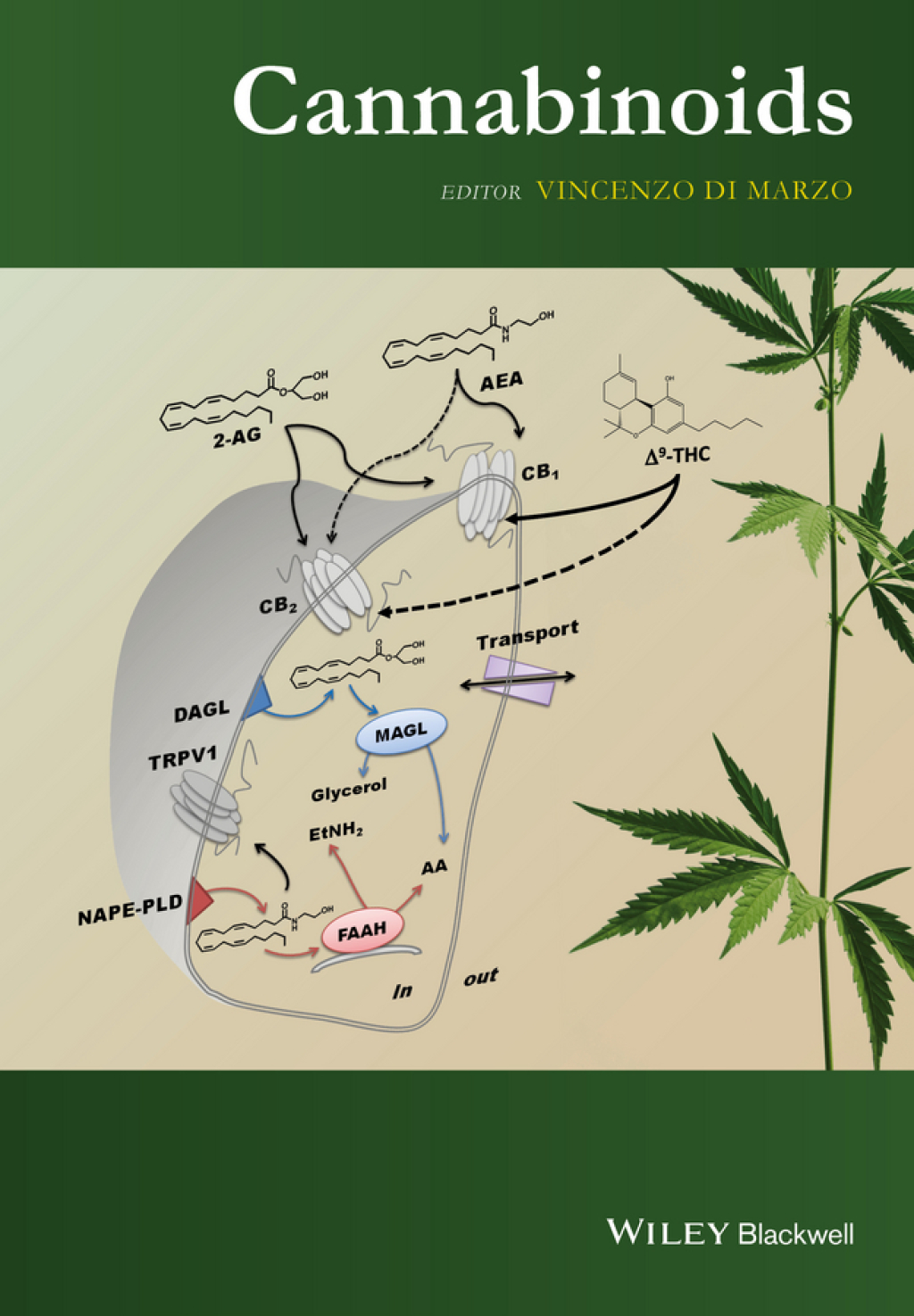
‘Cannabinoids’ is a broad term covering a group of natural products from Cannabis sativa, one of which locks on to specific receptors – protein molecules on the surface of cells – known as cannabinoid receptors. Over the past decades scientists have found that cannabinoid receptors and their endogenous ligands, the endocannabinoids, are involved in a vast array of physiological functions, including helping to control brain activity, energy metabolism, heart function, the immune system and even reproduction. In Cannabinoids, Vincenzo Di Marzo has assembled contributions from international experts to provide the definitive guide to what continues to be a rapidly developing research field. After an introductory historical chapter, the book continues by looking at the biochemical, genetic and molecular elements of cannabinoids, followed by chapters covering their role in health and disease. The final chapter outlines the need for a new nomenclature to reflect the complex and multi-disciplinary nature of this area.Â
Related products
Cannabinoids 1st Edition – PDF/EPUB Version Downloadable
Author(s): Roger G. Pertwee
Publisher: Springer
ISBN: 9783540225652
Edition: 1st Edition
$49,99
Delivery: This can be downloaded Immediately after purchasing.
Version: Only PDF Version.
Compatible Devices: Can be read on any device (Kindle, NOOK, Android/IOS devices, Windows, MAC)
Quality: High Quality. No missing contents. Printable
Recommended Software: Check here
Important: No Access Code
Description
Less than 20 years ago the ?eld of cannabis and the cannabinoids was still c- sidered a minor, somewhat quaint, area of research. A few groups were active in the ?eld, but it was already being viewed as stagnating. The chemistry of cannabis 9 9 was well known, ? -tetrahydrocannabinol (? -THC), identi?ed in 1964, being the only major psychoactive constituent and cannabidiol, which is not psychoactive, possibly contributing to some of the effects. These cannabinoids and several s- thetic analogs had been thoroughly investigated for their pharmacological effects. Their mode of action was considered to be non-speci?c. The reasons for this – sumption were both technical and conceptual. On the technical side, it had been shown that THC was active in both enantiomeric forms (though with a different level of potency) and this observation was incompatible with action on biological substrates—a receptor, an enzyme, an ion channel—which react with a single stereoisomer only. The conceptual problem related to THC activity. This had been pointed out by several highly regarded research groups that had shown that many of the effects seen with cannabinoids were related to those of biologically active lipophiles, and that many of the effects of THC, particularly chronic ones, were comparable to those seen with anaesthetics and solvents.